

By Pedro Fossat, DANA Technology ApS
In the pet food industry, every gram counts. A gram wasted is profit lost. Manufacturers face the daily challenge of turning low-value cuts and by-products into sellable, high-quality products.
But how can manufacturers turn these underutilized by-products into something pets find desirable and, at the same time, is great for business? At DANA Technology ApS, we believe an advanced texturization process answers those questions.
Through mechanical rotation and heating, texturization technology turns emulsified meats into fibrous chunks that mimic real meat’s appearance, feel, and taste—maximizing the value of by-products or lower-value ingredients.
From by-products to premium products
One of the most significant opportunities for pet food manufacturers is repurposing what would traditionally be waste or ingredients used in low-end products—such as machine-separated meat from the bone, poultry and fish trimmings, and prime cut-offs to mention a few.
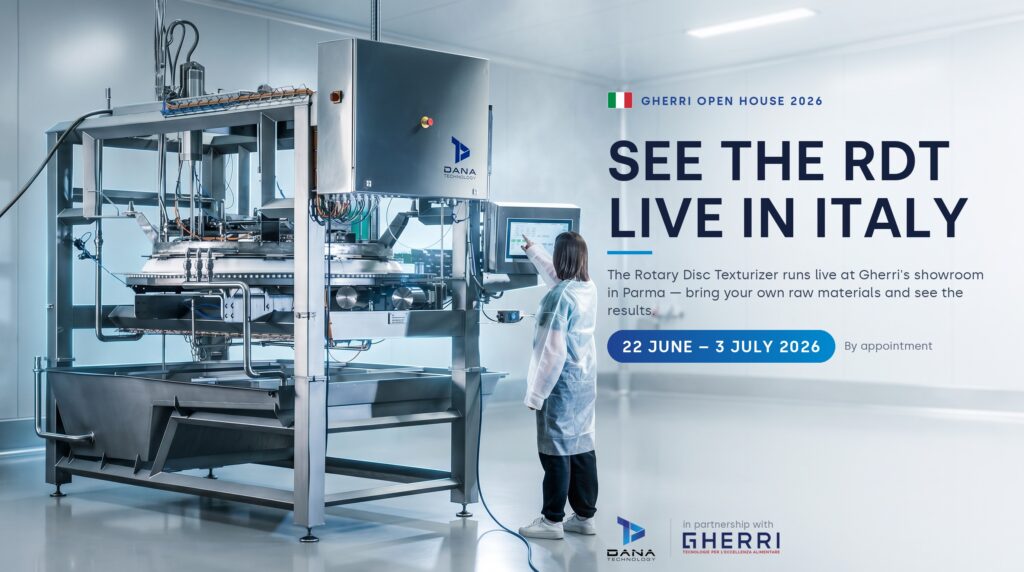
Instead of being used for low-value applications such flour, oil or biogas production, these materials can, compared to traditional chunks, now be turned into high-quality textured protein using a Rotary Disc Texturizer (RDT) from DANA Technology ApS, a Denmark-based company focused on pet food machinery.
The RDT leverages mechanical rotation and thermal energy to coagulate proteins and carbohydrates, creating a meat-like texture that delivers real meat’s bite, chew, and elasticity. The result is a product that maintains the natural appearance pets and their owners find appealing, making it an ideal solution for premium pet food.
Texturization relies on the rapid denaturation and coagulation of proteins within the emulsion. As the RDT applies heat and constant movement, proteins undergo structural changes that, depending on the protein type, occur between 50 and 70°C. This precise process creates a fibrous, meat-like texture, allowing denatured proteins to aggregate and form solid chunks.
Making pet food production sustainable
The RDT offers a practical solution for repurposing by-products and supports sustainability by reducing manufacturers’ reliance on prime cuts typically used for human consumption. This shift contributes to a more resource-efficient food production system and allows pet food manufacturers to enhance their competitive advantages in a tough market.
Vagn Hansen, CEO of DANA Technology ApS, explains: “Our RDT allows manufacturers to transform by-products into high-quality products that meet the growing demand for sustainability and profitability in the pet food industry—and it is a way to increase profit from day one.”
As the pet food industry evolves, the RDT is leading the charge, providing manufacturers with a powerful solution to meet market demands for sustainability, quality, and profitability.
Meet us at Zoomark 2025
This year, we’re excited to attend Zoomark 2025, the international exhibition for the pet food industry. If you’re attending, we would love to meet you, discuss your production goals, and explore how DANA’s solutions can make a difference to your production facilities.
You’ll find us in Hall 26, Booth C88, where we’ll showcase the DANA Steam tunnel and the DANA RDT—two technologies helping pet food manufacturers create high-quality wet food and premium chunks with an appealing and crunchy texture.
If you’re exploring ways to improve your production or want to exchange ideas about the future of pet food, let’s connect in Bologna. See you there.
Contact
Pedro Fossat
Head of Sales
pfo@dana-technology.dk
+45 44 12 70 43