
At DANA, we have developed a counter-flow concept for our wet pet food tunnel. It reduces the energy needed to heat the final chunk product by up to 30%. The tunnel recovers heat from the cooling stage and uses it to pre-heat the incoming product.
A steam-heated or electrically heated tunnel uses energy every hour a wet pet food line runs. The counter-flow concept lowers that energy use without changing how the product is cooked. Our data shows that the tunnel uses up to 30% less energy than standard processing tunnels.
How the counter-flow concept works
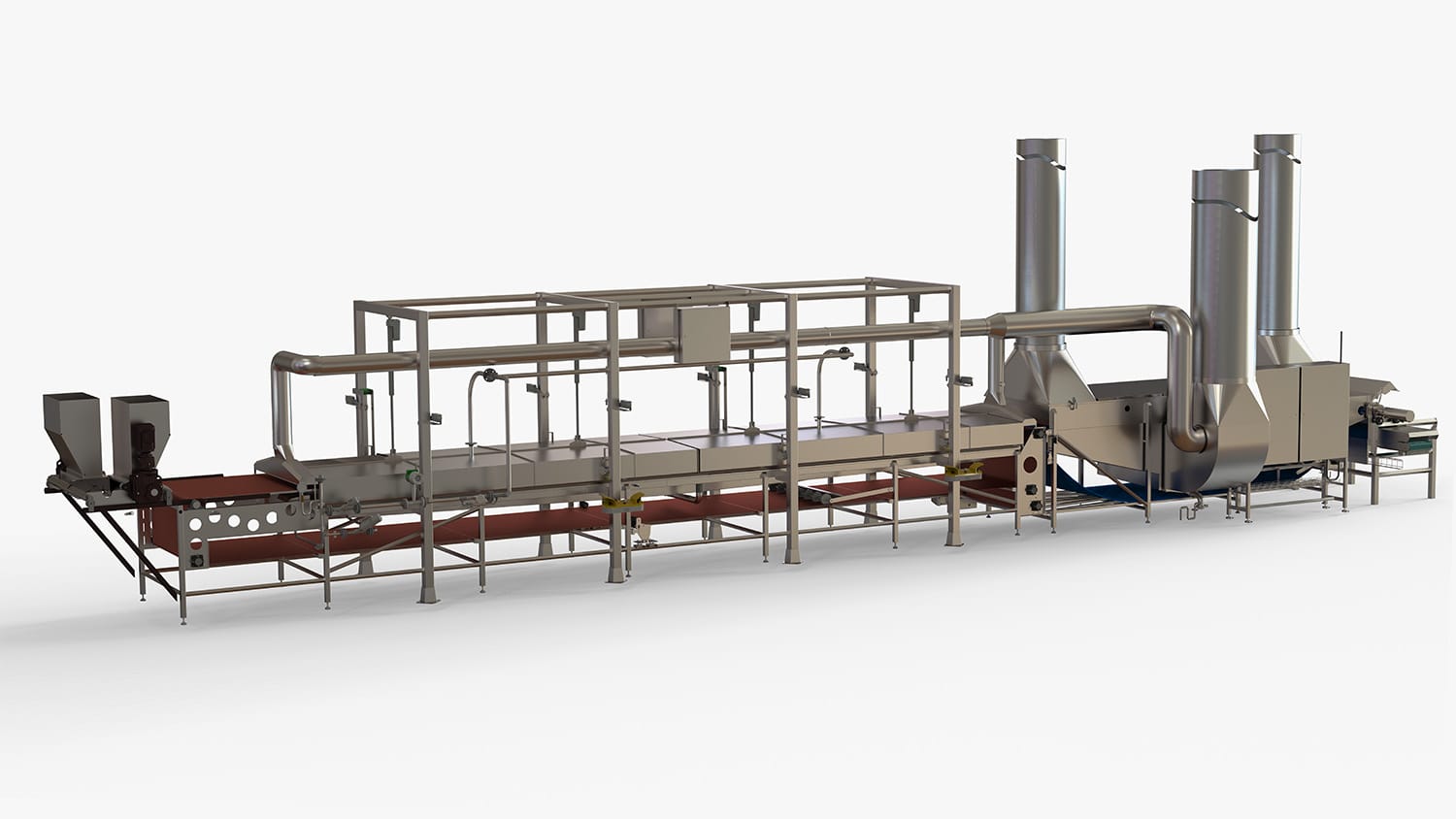
Cooking and cooling take place on a continuous belt conveyor, as in a standard tunnel. We set the air volume and air velocity in the cooling section to match the capacity of the line. This lets the tunnel cool the final chunk product and collect its heat in the same step.
After cooking, the cooling air takes up heat and moisture from the product. A fan moves this warm air through a separate, insulated pipe. The pipe bypasses the cooking zone and leads into a pre-heating tunnel connected to the cooking tunnel.
In the pre-heating tunnel, the warm air flows from the discharge end toward the infeed end, against the direction of the product. The air passes its heat to the colder product before the product enters the cooking zone. The cooking zone then needs less energy to bring the product to temperature.
The DANA Steam and Cooling Tunnel handles 500 to 4,000 kg per hour. We can scale the design for higher outputs.
Part of a full wet pet food line
We deliver the tunnel as part of a full wet pet food line with feeding pumps, extruders and cutters. You can choose between two tunnels: the DANA Standard Steam Cooking and Evaporative Cooling Tunnel, or the DANA Steam and Cooling Tunnel with counter-flow cooling and pre-heating.
We handle every stage directly, from specification and engineering to commissioning. Each setup is adapted to your existing production.
Frequently asked questions
How much energy does the DANA Steam and Cooling Tunnel save?
Our data shows that the tunnel uses up to 30% less energy to heat the final chunk product than standard processing tunnels.
Does the counter-flow concept change how the product is cooked?
No. Cooking and cooling take place on a continuous belt conveyor, as in a standard tunnel. The concept only pre-heats the product before it enters the cooking zone.
Where does the recovered heat come from?
After cooking, the cooling air takes up heat and moisture from the product. A fan moves this warm air through a separate, insulated pipe that bypasses the cooking zone and leads into the pre-heating tunnel.
How does the pre-heating tunnel work?
The warm air flows from the discharge end toward the infeed end, against the direction of the product. The air passes its heat to the colder product, so the cooking zone needs less energy to bring the product to temperature.
Does the concept work with both steam and electric heating?
Yes. The counter-flow concept applies to both steam-heated and electrically heated tunnels.
What capacity does the tunnel handle?
The DANA Steam and Cooling Tunnel handles 500 to 4,000 kg per hour. We can scale the design for higher outputs.
What does DANA deliver with the tunnel?
We deliver the tunnel as part of a full wet pet food line with feeding pumps, extruders and cutters. We handle every stage from specification and engineering to commissioning, and adapt each setup to your existing production.